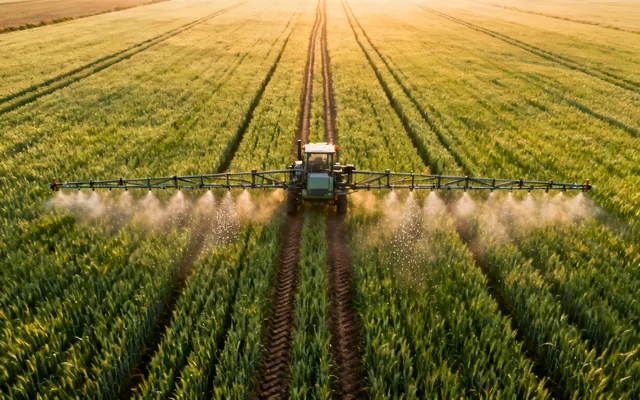
Row-crop throughput
Large rectangular fields reward mature boom rate control. Document hectares per fill, boom height sensor behavior and refill route time so the claimed daily coverage remains credible under real wind and mud limits.
Use this matrix to connect crop canopy, boom geometry and drift risk to a recommended sprayer family. For 2025–2026 RFQs, drone spraying versus boom sprayers remains a live industry trade-off: drones suit fragmented or steep parcels, while boom platforms still lead large-block throughput when rate control maturity and refill logistics dominate.
Each row states the demand signal, the equipment family typically reviewed, and the metrics procurement should ask for before freezing a shortlist.
| Crop / scenario | Primary demand | Recommended family | Metrics to verify |
|---|---|---|---|
| Cereal row crops | High hectares/day with consistent L/ha across wide booms | Trailed or self-propelled boom sprayer | Working width (m), tank (L), section count, spray drift buffer plan |
| Oilseed / canola blocks | Flowering windows and neighbor-sensitive drift edges | Boom sprayer with fine section control | Nozzle chart class, wind threshold, headland shut-off behavior |
| Orchards | Canopy penetration in alleys with limited boom swing | Orchard / air-assisted configurations | Air volume, row spacing fit, deposition sampling method |
| Vegetables & specialty | Tight residue windows and smaller parcels | Mounted or compact trailed sprayers | Tank cadence, rate band accuracy, washdown protocol |
| Fragmented / steep terrain | Access where large booms cannot track safely | Agricultural drone or mist blower (case review) | Coverage efficiency, payload cycles, regulatory flight limits |
| Mixed livestock farms | Pasture and forage weed control with shared tractor fleet | 3-point / PTO-driven sprayers | PTO power, tank size, boom fold footprint |
Large rectangular fields reward mature boom rate control. Document hectares per fill, boom height sensor behavior and refill route time so the claimed daily coverage remains credible under real wind and mud limits.
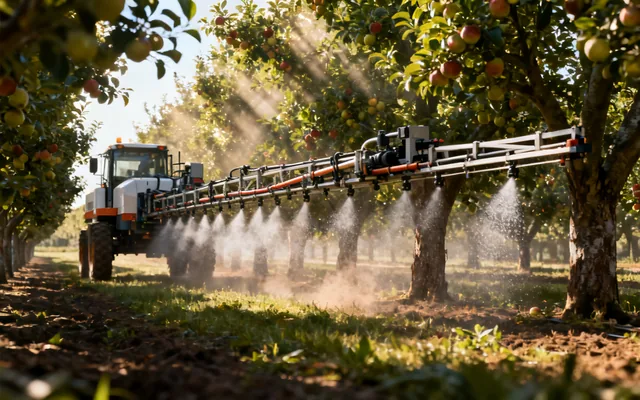
Canopy density changes the useful droplet spectrum. Ask for deposition checks on leaf surfaces and for alley-width clearances before assuming a row-crop boom will transfer cleanly into orchard geometry.
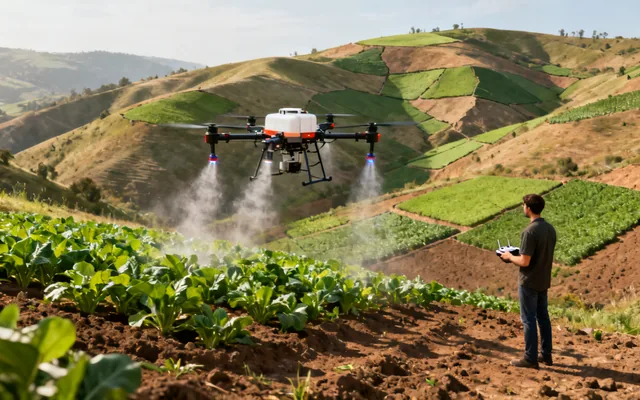
When parcels are fragmented or steep, drones can reduce setup friction and keep payload cycles workable on awkward terrain. For contiguous blocks above roughly 40 ha with stable tramlines, a boom sprayer with 24–36 m working width and 2000–5000 L tank options usually sustains higher hectares/day once rate control, section logic and refill routing are proven. Record both sides against the same wind and buffer rules before freezing the shortlist.
Use the same evaluation sheet for both options. Scores below are decision dimensions, not ranked brand claims.
| Dimension | Agricultural drone | Boom sprayer |
|---|---|---|
| Coverage efficiency | Strong on fragmented or steep parcels; payload cycles limit continuous hectares | Higher sustained ha/day on contiguous blocks with stable tramlines |
| Spray drift control | Depends on altitude, droplet spectrum and wind; local flight rules apply | Mature nozzle charts, boom height and section shut-off for buffer edges |
| Rate / tank logistics | Smaller tanks; more refill or battery cycles per treated hectare | 2000–5000 L tank classes with modeled refill routes |
| Controls maturity | Mission planning and altitude hold vary by airframe and software revision | Rate control, section logic and as-applied logs are widely established |
Coverage rates, drift percentages and deposition scores depend on nozzle wear, boom height, product formulation, wind and operator practice. Hardi materials on this site do not present a single universal L/ha or “zero drift” outcome.
GLOBALG.A.P., ISO 9001 and CE references describe review frameworks or market access topics. Applicability to a specific machine, market and legal entity must be confirmed with current certificates and local rules.
Include hectares by crop, terrain notes and whether you need trailed, self-propelled, mounted or drone-assisted options. We return a bounded shortlist with the metrics still open for verification.